Written Test Preparation — Pass With Confidence
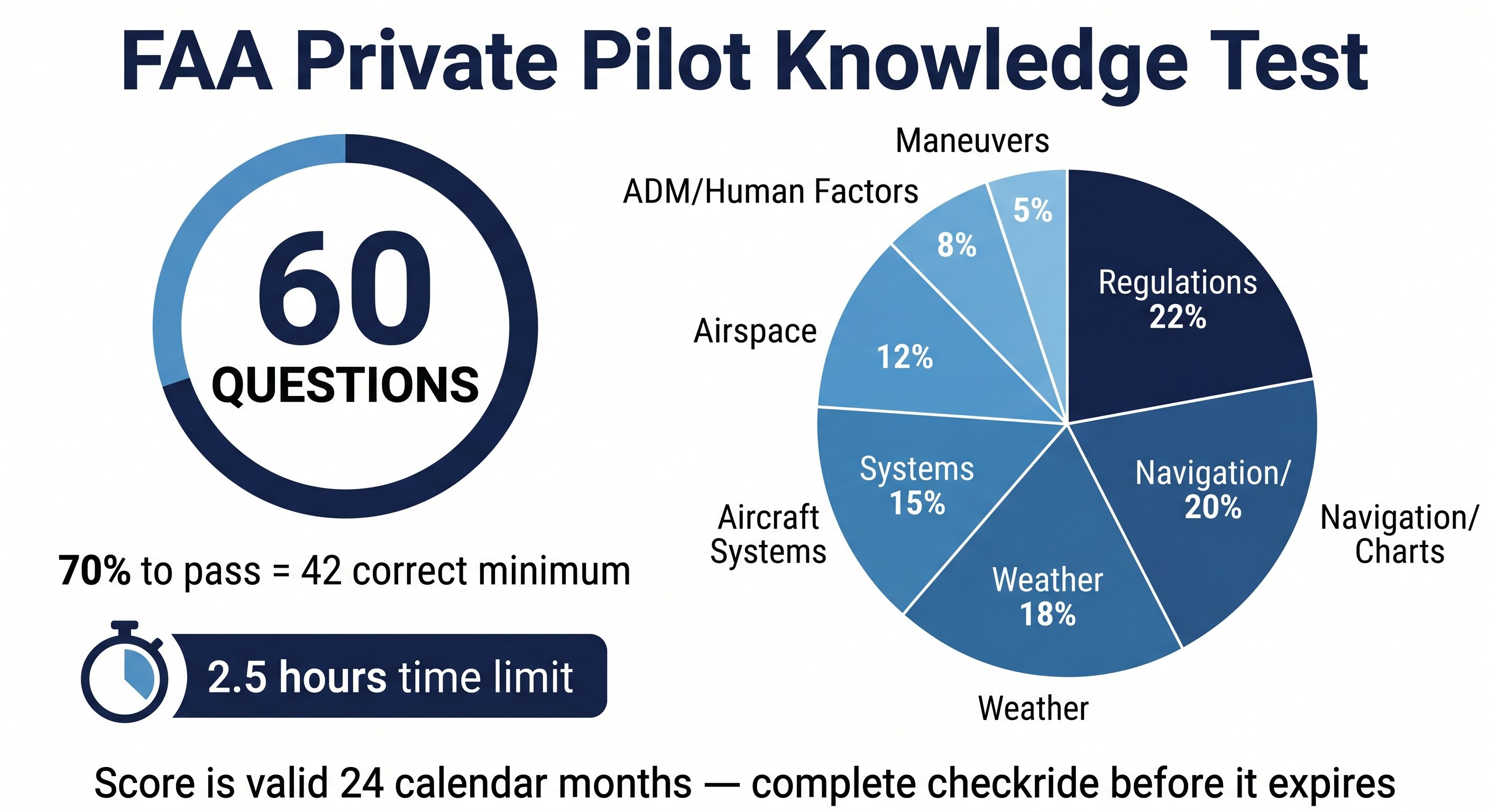
The FAA Private Pilot Knowledge Test is 60 questions with a 70% passing score — you need to answer at least 42 correctly. Questions draw from every module in this course. This module explains the test format, the most heavily tested topics, the specific question types that trip up students, and a study strategy that produces passing scores reliably.
- Describe the knowledge test format, administration, and score requirements
- Identify the most heavily tested topics by category weight
- Explain common question traps and how to defeat them
- Describe effective test preparation strategies for different learning styles
- Apply the mark-and-return strategy for difficult questions during the test
- Review the highest-priority topics from each module
- Use the final quiz as a mixed-topic diagnostic before scheduling your test
Lesson 1 — The Knowledge Test: Format and Administration
The FAA Private Pilot Airplane Knowledge Test (PAR) consists of 60 multiple-choice questions drawn from the FAA's published question bank. You have 2.0 hours to complete it — far more than most students need. The passing score is 70%, meaning you must answer at least 42 of 60 questions correctly.
The test is computer-administered at FAA-approved testing centers (CATS and PSI locations). You receive your score immediately after completion. A passing score is valid for 24 calendar months — if you don't complete your checkride within that window, you must retest. Your CFI must provide a logbook endorsement certifying you are prepared before you can take the test.
Question category breakdown
The FAA publishes approximate category weights for the knowledge test. Understanding which areas carry the most questions tells you where to focus your study time:
| Topic Area | Approx. Questions | Key subtopics |
|---|---|---|
| Regulations (Parts 61, 91) | 12–14 | Currency, flight review, documents, speed limits, altitudes, right-of-way, fuel |
| Navigation & Charts | 10–12 | TVMDC, sectional chart reading, TVMDC, VOR, E6B calculations |
| Aviation Weather | 10–12 | METAR decode, TAF groups, AIRMETs/SIGMETs, icing, thunderstorms |
| Aircraft Systems & Performance | 8–10 | Weight and balance, density altitude, performance charts, systems |
| Airports & Airspace | 6–8 | Class B/C/D/E/G requirements, equipment, communications |
| ADM & Human Factors | 5–6 | Hazardous attitudes, IMSAFE, PAVE, accident chain |
| Flight Maneuvers | 4–5 | ACS tolerances, stalls, density altitude effects |
| Cross-Country Planning | 4–5 | Fuel calculations, ETAs, weight and balance, nav log |
Study allocation strategy: Regulations (20%), Navigation (20%), and Weather (20%) together account for roughly 60% of the test. Master these three areas first and you have a strong baseline. Performance calculations and airspace add another 20–25%. ADM and maneuvers questions tend to be straightforward if you've studied the material.
Test day logistics — what to bring and what to expect
The knowledge test is administered at FAA-approved testing centers (PSI and CATS are the main providers). Find a center near you at faa.psiexams.com. You must schedule in advance — walk-ins are typically not accepted. Bring:
- Government-issued photo ID: Driver's license, passport, or military ID
- Logbook endorsement: Your CFI must endorse your logbook certifying you're prepared for the knowledge test (FAR 61.35 requires this). Take a photo of it as a backup.
- E6B flight computer: Mechanical (circular slide rule type). Not an electronic E6B — the test center will provide a non-programmable calculator if needed, but your own mechanical E6B is allowed and preferable if you've practiced on it.
- Plotter: For sectional chart questions. Many test centers provide them, but bring yours if you've trained on it.
- No phones, no electronic devices other than what the center provides
The test is computer-based. You'll see one question at a time, some with associated figures (charts, diagrams, tables) displayed alongside. You can flag questions to return to and review. When you submit, your score appears immediately. 70% is passing — 42 of 60 questions correct.
After the test — what the score report means
Your score report shows your overall score and which knowledge areas you missed questions in. It does not tell you the specific questions you missed. The knowledge area breakdown is important: if you missed multiple questions in "Navigation / Charts," that's where your studying for the oral exam and checkride should focus. DPEs review your knowledge test score report during the oral and may probe areas where you scored low.
If you don't pass: you must wait 14 calendar days before retesting. Use that time to study specifically the areas where you scored poorly — use an FAA practice test app to drill those categories. When you retest, you'll get a different but overlapping set of questions from the same published bank. Your CFI must provide another endorsement before the retest.
Your passing score is valid for 24 calendar months. If you don't complete the checkride within 24 months, you must retake the knowledge test. Don't let it lapse — schedule your checkride within a reasonable timeframe after the test while the material is fresh.
Lesson 2 — The Most Common Traps
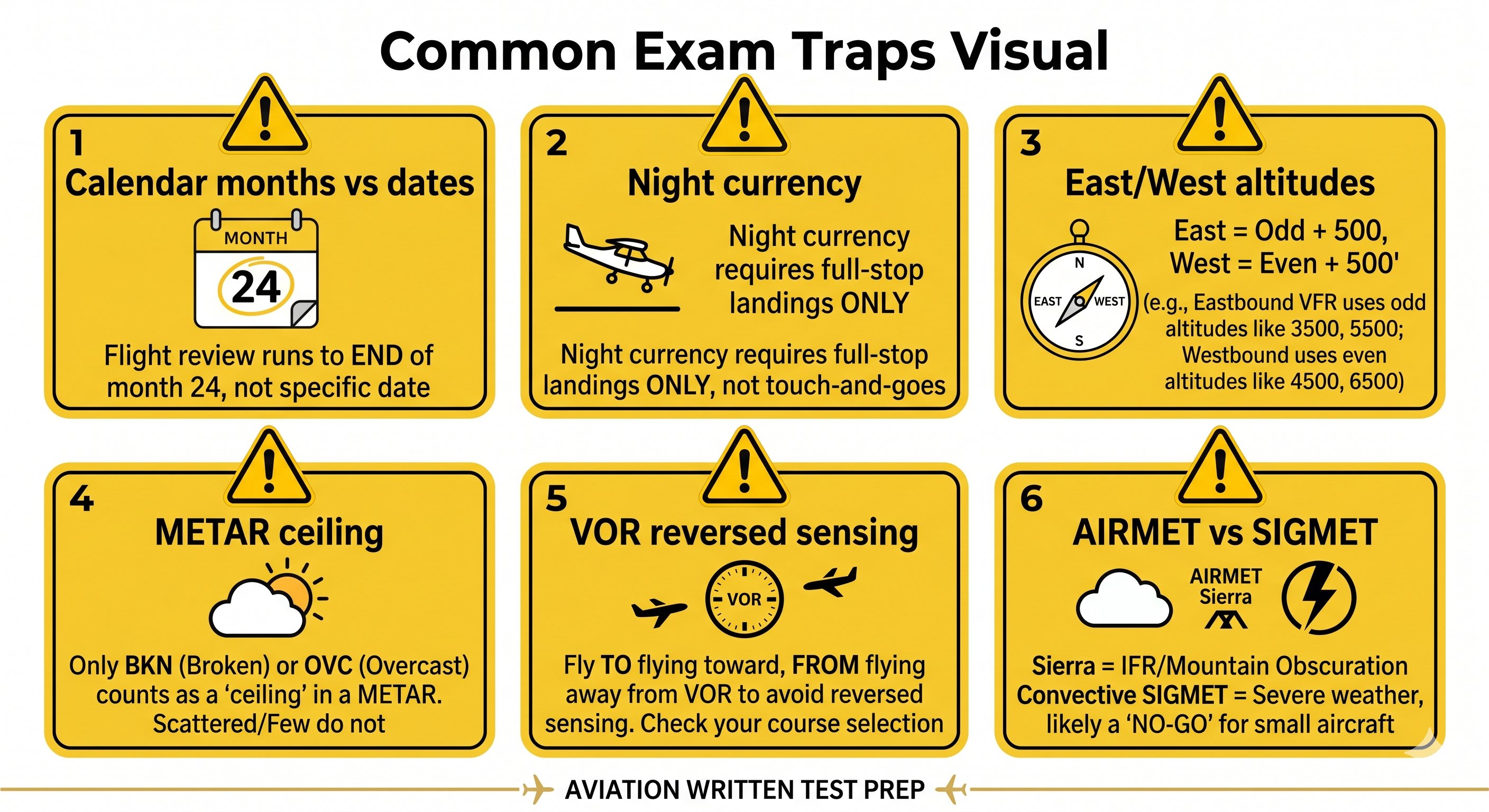
Certain question formats and topic areas consistently trap students who understand the material but miss the nuance. Recognizing these traps is worth more study time than general review.
Trap 1: Calendar months vs. specific dates
Flight review, aircraft inspections, and currency calculations use calendar months — not 24 months from a specific date. A flight review completed on March 15, 2024 is valid through March 31, 2026 — not March 15, 2026. Similarly, a 100-hour inspection that should have been done at 500 hours but was done at 510 hours: the next inspection is due at 600 hours, not 610.
Trap 2: AIRMET vs. SIGMET — which applies to VFR?
Students frequently confuse which weather advisory they should be most concerned about. The key hierarchy: Convective SIGMET > SIGMET > AIRMET Sierra > AIRMET Zulu > AIRMET Tango for VFR impact. An active Convective SIGMET is the most serious — it is never routeable around for VFR. AIRMET Sierra means actual IFR conditions are present — check your route carefully. AIRMET Zulu means icing at the altitudes stated — avoid in visible moisture.
Trap 3: East vs. West VFR cruising altitudes
The rule: Eastbound (0–179°) = Odd thousands + 500. Westbound (180–359°) = Even thousands + 500. The trap: questions frequently specify a magnetic course and ask which altitude is appropriate. Identify east vs west first, then select the correct altitude from the choices. Also remember: this rule only applies above 3,000 ft AGL and to VFR flight — IFR traffic uses even/odd thousands without the +500.
Trap 4: "Preceding" vs "preceding calendar months"
Passenger currency requires 3 takeoffs and landings in the "preceding 90 days" — a rolling 90-day window. Flight review requires completion within the "preceding 24 calendar months" — which extends to end of month 24. These use different counting methods. Questions designed to trip you up will mix the concepts.
Trap 5: METAR sky condition — what constitutes a ceiling?
Only BKN (broken) and OVC (overcast) layers constitute a ceiling. FEW (1–2/8) and SCT (3–4/8) do not. A METAR showing "FEW018 BKN045" has a ceiling at 4,500 ft AGL — not 1,800 ft. This matters for VFR flight category classification and for determining whether VFR flight is legal.
Trap 6: Night passenger currency — full-stop required
Day passenger currency can be maintained with touch-and-go landings. Night passenger currency requires full-stop landings. Many students maintain currency with touch-and-goes and don't realize they are not current to carry night passengers even if their 3 recent landings were at night.
Trap 7: VOR TO/FROM flag with reversed sensing
When the TO flag is selected but you are flying away from the station (or the FROM flag with flying toward), CDI deflections are reversed — turning toward the needle takes you further off course. Questions often present a VOR scenario and ask "what should the pilot do?" — if the flag and direction of travel are mismatched, the answer may be to select the correct OBS setting, not to follow the CDI.
The "most nearly" and "approximately" traps: Some E6B questions accept answers within a tolerance range. When two answer choices look correct, double-check your calculation. Questions asking for "approximately" are often testing whether you can do reasonable mental math estimates — the exact E6B answer may round differently from the "closest" option.
The trap questions that sink passing scores
These questions appear in nearly every version of the test and have a high miss rate. Study these specifically:
The "LEAST" and "NOT" questions: "Which is NOT a required document?" or "Which would LEAST likely cause carburetor ice?" These require identifying the wrong answer, not the right one. Slow down, underline the NOT or LEAST, eliminate the obviously wrong answers, and double-check your final selection makes sense as an answer to the reversed question.
Airspace questions with "floor" traps: "An aircraft is flying at 7,500 ft MSL over terrain at 7,000 ft MSL. What are the applicable VFR weather minimums?" The answer depends on which airspace — at 500 ft AGL, you could be in Class G (if no Class E below 1,200 AGL). Many students apply Class E minimums when the answer is Class G.
Calendar month vs. specific date: "A pilot completed a flight review on March 15. When does it expire?" Answer: March 31 two years later — the end of the 24th calendar month. Not March 15. This distinction trips up students on flight review, passenger currency, and inspection questions alike.
Magnetic vs. true course questions: "Using the E6B to find ground speed — do you use true airspeed or calibrated airspeed?" True airspeed. "For VFR cruising altitudes, do you use true course or magnetic course?" Magnetic course. The test mixes these to see if you know which measurement applies where.
Lesson 3 — High-Priority Number Facts
The written test requires a large number of specific numerical values to be memorized. Unlike the oral, where you can look things up, the knowledge test has no references — all numbers must be recalled. Here are the most commonly tested specific values:
Currency and time limits
- Passenger currency: 3 takeoffs/landings in preceding 90 days
- Night passenger currency: full-stop, during night period (1 hr after sunset to 1 hr before sunrise)
- Flight review: every 24 calendar months
- Instrument currency: 6 approaches + holds + tracking in preceding 6 calendar months
- Alcohol: 8 hours bottle to throttle minimum; 0.04% BAC limit
- Knowledge test valid: 24 calendar months
Inspection intervals
- Annual: every 12 calendar months
- 100-hour: every 100 hours (aircraft used for hire/instruction)
- Transponder: every 24 calendar months
- Altimeter/static system: every 24 calendar months (IFR only)
- VOR: every 30 days (IFR only)
- 100-hour overrun: up to 10 hours to fly to maintenance — but next interval calculated from where it should have been
Speed limits
- Below 10,000 ft MSL: 250 KIAS
- Within Class B: 200 KIAS
- Within 4 nm of Class C or D, below 2,500 AGL: 200 KIAS
Minimum altitudes
- Congested areas: 1,000 ft above highest obstacle within 2,000 ft radius
- Other than congested: 500 ft above surface
Fuel requirements
- Day VFR: destination + 30 minutes at normal cruise
- Night VFR: destination + 45 minutes at normal cruise
Weather thresholds
- VFR: ceiling above 3,000 ft AGL, visibility greater than 5 SM
- MVFR: ceiling 1,000–3,000 ft / vis 3–5 SM
- IFR: ceiling 500–999 ft / vis 1–3 SM
- LIFR: ceiling below 500 ft / vis below 1 SM
- AIRMET issued for: IFR conditions (ceiling <1,000 AGL / vis <3 SM over 3,000+ sq miles)
The complete number bank — all testable values in one place
The knowledge test requires recall of many specific numerical values. This is a comprehensive reference for the most tested numbers:
3 TO/landings — passenger currency
24 calendar months — flight review
6 months — instrument currency (IFR)
6 approaches — instrument currency
45 min — VFR night reserve
45 min — IFR alternate reserve
Full tanks — takeoff requirement (VFR)
10,000 ft MSL — 250 KIAS limit applies below
10,000 ft MSL — Class E enhanced mins above
18,000 ft MSL — Class A begins (FL180)
500 ft / 1,000 ft / 2,000 ft — cloud clearances
100 hours — for hire/flight instruction
24 calendar months — altimeter/pitot-static
24 calendar months — transponder
12 calendar months — ELT
200 KIAS — Class B airspace
200 KIAS — Class C/D surface area (4 nm)
156 KIAS — Vg typical Cessna 172
1 SM — Class G day below 1,200 AGL
5 SM — Class E above 10,000 MSL
Clear of clouds — Class B
500/1,000/2,000 — standard cloud clearances
Numbers the test always asks — organized by category
Beyond the grid already shown, here are the specific number combinations that appear as trick questions:
Cruising altitude rule: The rule applies "more than 3,000 feet above the surface" — not 3,000 ft MSL. Students who memorize "above 3,000 feet" miss questions set above high terrain where the actual AGL is below 3,000 ft.
Cloud clearances: Class B = clear of clouds (no distance). Class G day below 1,200 AGL = clear of clouds (no distance). Every other controlled airspace = 500 below, 1,000 above, 2,000 horizontal. Class E above 10,000 MSL = 1,000 below, 1,000 above, 1 mile horizontal. The test uses all four combinations.
Oxygen requirements: 12,500–14,000 ft = crew must use O2 after 30 min. Above 14,000 ft = crew must use O2 at all times. Above 15,000 ft = passengers must be provided O2. These three thresholds are tested together in a single question regularly.
Lesson 4 — E6B Practice Problems
E6B calculations account for 6–10 questions on most tests. You cannot bring a smart device, but you can bring an E6B flight computer and calculator to the test. Practice until the E6B operations are automatic.
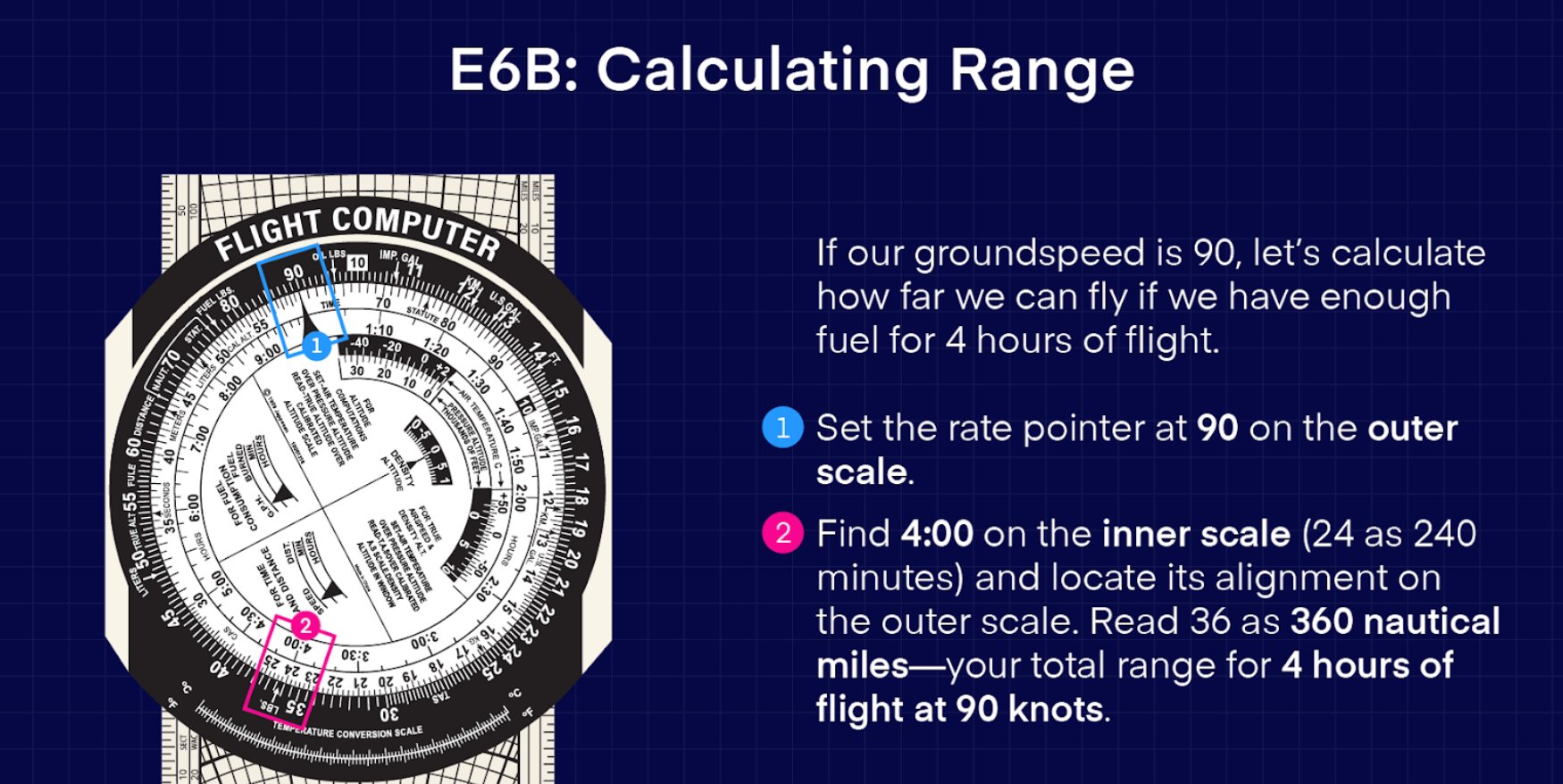
Practice problems — work these before your test:
TSD-1: GS = 135 kts, Distance = 270 nm. Time?
Answer: 270 ÷ 135 = 2.00 hrs = 2 hours exactly
TSD-2: Time = 1 hr 24 min, Distance = 105 nm. Groundspeed?
Answer: 105 ÷ (84/60) = 105 ÷ 1.4 = 75 kts
FUEL-1: Fuel flow 8 GPH, flight time 2 hr 15 min. Fuel used?
Answer: 8 × 2.25 = 18 gallons
FUEL-2: Usable fuel 40 gal, flow 10 GPH, day VFR reserve required?
Answer: Reserve = 0.5 hr × 10 = 5 gal. Available for flight = 40 − 5 = 35 gal. Max flight time = 35 ÷ 10 = 3.5 hours
TVMDC: TC = 310°, Variation = 14°E, Deviation = +3°. Compass heading?
Answer: TC 310 − 14 (E is Least) = MC 296 + 3 (deviation) = 299° compass heading
Five complete E6B problems with worked solutions
Work all five before your test. Use your actual E6B mechanical computer on each one:
Problem 1 — Time-Speed-Distance: You depart at 1435Z. Your destination is 167 nm away. Your planned groundspeed is 112 knots. What is your ETA?
Solution: Time = Distance ÷ GS = 167 ÷ 112 = 1.49 hours = 1 hour 29 minutes. ETA = 1435 + 1:29 = 1604Z.
Problem 2 — Fuel Required: You plan a flight of 2 hours 15 minutes. Fuel burn is 9.5 GPH. You need a 30-minute VFR day reserve. How much fuel do you need?
Solution: Total flight time = 2:15 + 0:30 = 2:45 = 2.75 hours. Fuel = 9.5 × 2.75 = 26.1 gallons.
Problem 3 — Wind Correction Angle: True course 090°, TAS 105 knots, wind from 340° at 25 knots. Find WCA and groundspeed.
Solution (E6B wind side): Plot wind from 340° at 25 knots. Set TC 090° under true index. Slide grid so wind vector tip is on the 105-knot arc. Read WCA from center: approximately 11° left (WCA = −11°). True heading = 090 − 11 = 079°. Read groundspeed from grommet: approximately 90 knots.
Problem 4 — Density Altitude: Airport elevation 4,200 ft MSL. Altimeter setting 29.70 inHg. OAT 35°C. Find density altitude.
Solution: Pressure altitude = 4,200 + (29.92 − 29.70) × 1,000 = 4,200 + 220 = 4,420 ft. On E6B density altitude window: align 4,420 PA with 35°C. Density altitude ≈ 7,400 ft.
Problem 5 — True Airspeed: Indicated airspeed 105 KIAS. Pressure altitude 7,500 ft. OAT 5°C. Find TAS.
Solution (E6B TAS window): Set 7,500 ft opposite 5°C on the CAS/TAS window. Read TAS opposite 105 KIAS: approximately 117 KTAS.
Using practice tests to identify gaps before the real test
The FAA publishes the complete question bank used for the knowledge test. Every reputable test prep app (Sporty's, Gleim, King Schools, ASA) draws from this same bank. If you practice with these apps until you're scoring consistently above 85%, you will pass the actual test — the questions are the same ones.
Strategy: take a full 60-question practice test under timed conditions (2.0 hours max). Score it. Identify the two or three knowledge areas with the lowest scores. Spend the next study session drilling only those areas. Repeat. Your score will climb quickly because you're targeting actual gaps rather than reviewing everything you already know.
The most efficient final preparation: 3–4 days before the test, take two full practice tests. If both score above 80%, you're ready. If either scores below 75%, identify the weak areas and spend another day drilling before your test date. Never take the real test while still scoring below 80% on practice — the stress of the real environment typically reduces performance by a few points.
Lesson 5 — Test-Taking Strategy
The mark-and-return technique
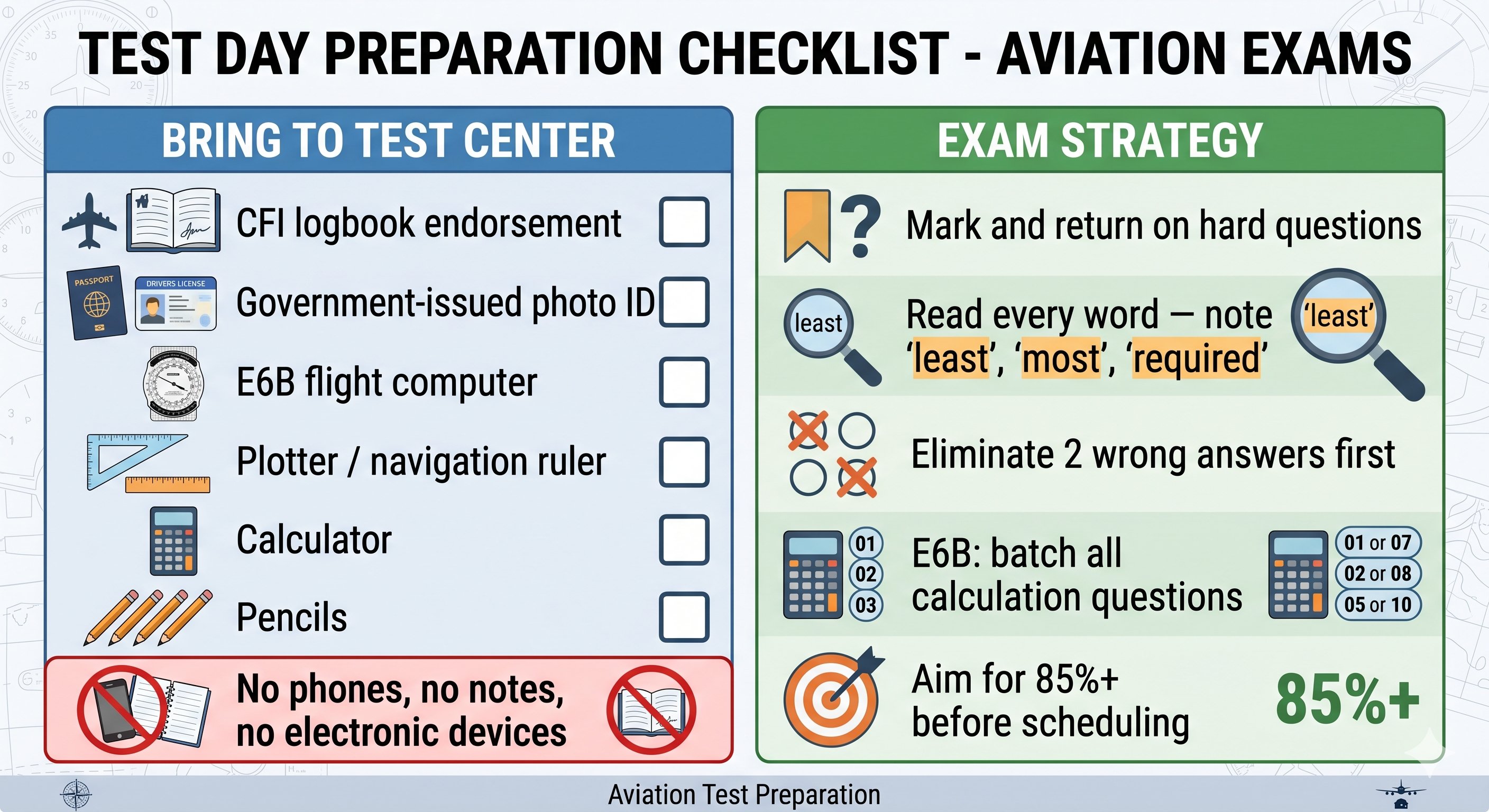
With 2.0 hours for 60 questions, you have 2 minutes per question — far more than most questions need. The optimal strategy: answer every question you know immediately (typically 30–40 seconds each). For questions you're unsure about, mark them and move on. After one pass through all 60, return to marked questions with remaining time. This approach ensures you don't waste time on hard questions while easy points wait untouched later in the test.
Eliminating wrong answers
Every multiple-choice question has 4 options. Typically 1–2 can be eliminated immediately as obviously wrong, leaving 2–3 plausible options. Even random selection from the remaining options produces better odds than guessing cold from 4. In aviation questions, watch for: "never" and "always" (usually wrong), "approximately" (tells you the answer doesn't have to be precise), and answers that are far outside the expected range (eliminate first).
Read the question exactly
Many questions are missed not from lack of knowledge but from misreading. Read every word. Note: "pilot's operating handbook" vs "airplane flight manual." "At least" vs "not more than." "During" vs "after." "Required" vs "recommended." "Magnetic course" vs "true course" vs "compass heading." These distinctions are often the entire point of the question.
E6B time management
If you have calculation questions, answer the non-calculation questions first. Then batch the E6B problems — it's faster to do all your calculations in sequence rather than setting up the E6B for one problem, putting it down, and picking it up again later. Time spent setting up the E6B is the same whether you do 5 calculations in a row or 1 at a time.
The mark-and-return technique in full detail
You have 2.0 hours for 60 questions — 2 minutes per question average. The mark-and-return technique maximizes your score by ensuring you never lose time on hard questions at the expense of easy ones:
Pass 1 (answer what you know): Go through all 60 questions. Answer every question you're confident about in 30–45 seconds. For any question you're uncertain about or that requires E6B calculations, mark it and skip. Most students complete 40–45 questions on the first pass.
Pass 2 (E6B questions): Return to all E6B and computation questions. Set up your E6B and calculator and do them all in sequence — you don't have to re-setup between similar problems. Batching calculation questions is significantly faster than doing them one at a time as they appear.
Pass 3 (remaining marked questions): Work through remaining marked questions with full attention. On multiple choice, eliminate obviously wrong answers first — even if you don't know the right answer, a 1-in-2 guess is better than 1-in-4.
Pass 4 (review): If time allows, review your answers — especially any you second-guessed. Research consistently shows that first instincts are more often correct than changed answers — only change an answer if you have a specific reason to believe the first was wrong, not just because you're second-guessing yourself.
Eliminating wrong answers — the logic approach
When you don't know the answer, logic can still get you there. Ask these questions about each option:
- Is this factually impossible? (eliminate)
- Does this option use language that's too absolute ("always," "never," "only") for a complex regulatory topic? (suspicious — regulations have exceptions)
- Does this option have numbers or specifics that seem inconsistent with what you know? (if the number is way outside the range you'd expect, it's probably wrong)
- Do two options say essentially the same thing differently? (if so, both are probably wrong — the answer is probably the third or fourth option)
The topics that appear in every practice test — guaranteed preparation
Based on the published FAA question bank, certain topics appear in virtually every version of the test. If you can answer questions on these fluently, you're covering approximately 70% of your score:
METAR decoding with ceiling determination (look for lowest BKN or OVC). TAF change groups (TEMPO, FM, BECMG, PROB30). VFR weather minimums by airspace class (especially the Class B and Class G exceptions). Pilot currency — the 90-day passenger rule and the "full stop" night requirement. AROW documents. Inspection intervals (annual, 100-hour, altimeter, transponder). VFR cruising altitudes with the "more than 3,000 AGL" threshold. Right-of-way rules with the full priority order. Density altitude — what it is, how to calculate it, and its effect on performance. Load factor in turns — the bank angle to G-force relationship and stall speed increase.
Lesson 6 — Cross-Referencing the Most Tested Concepts
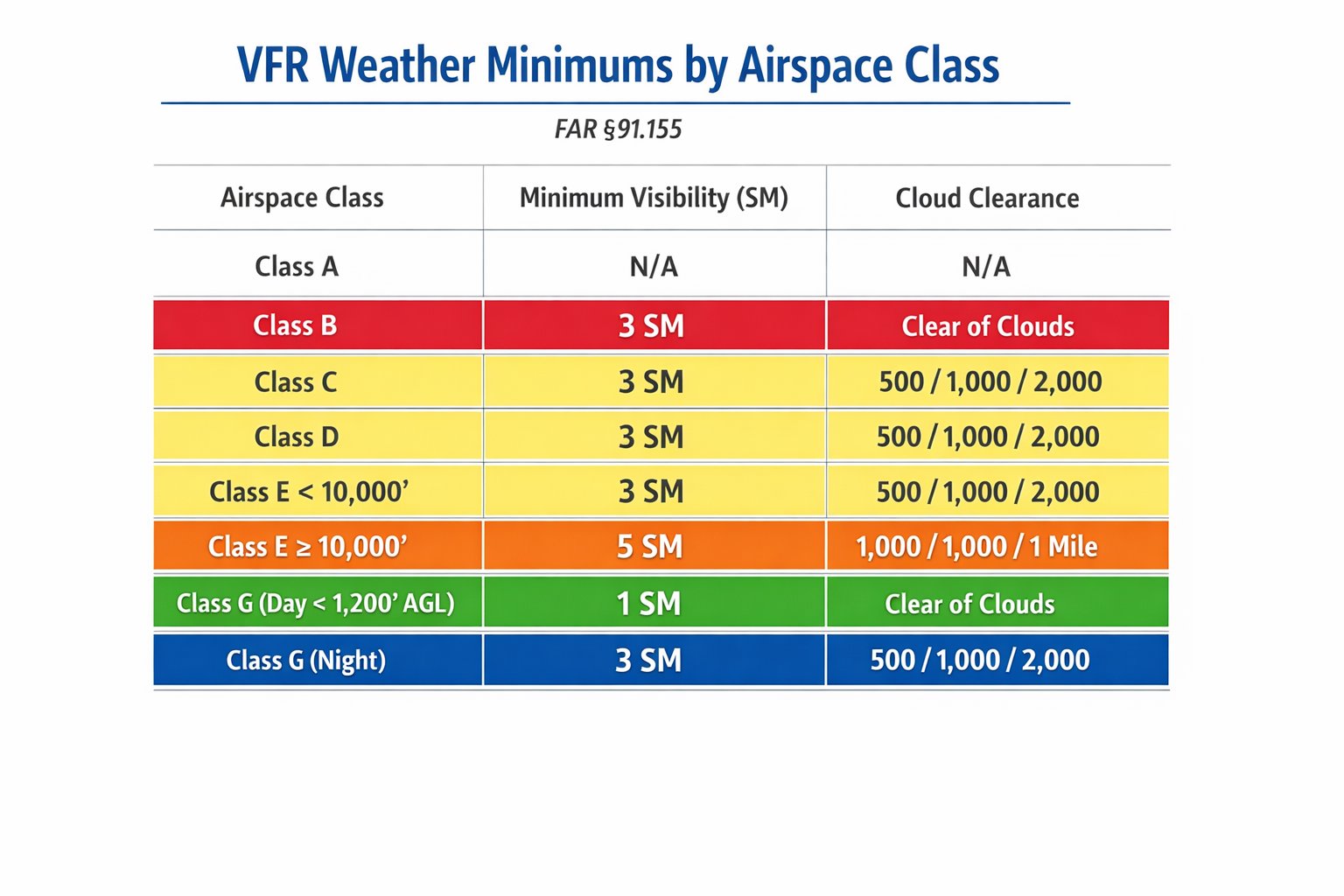
The following topics are tested in almost every version of the written test. If you can answer questions on these confidently, you are very likely to pass:
From Module 6 (Navigation): Full TVMDC conversion with East/West variation rules. Reading the airport data block on a sectional chart. What MEF numbers mean and how to use them. VOR CDI interpretation — all three situations (centered TO, deflected TO, centered FROM). E6B TSD calculations.
From Module 7 (Weather): Complete METAR decode — every group. TAF time group meanings (FM, TEMPO, PROB30). AIRMET Sierra/Tango/Zulu — what each covers and what it means for VFR. VFR flight categories and the ceiling/visibility thresholds. Thunderstorm avoidance rules (20 nm, never penetrate, never fly below).
From Module 8 (Regulations): Passenger currency (90 days, 3 takeoffs/landings, same category/class). Night currency (full stop, night period). Flight review (24 calendar months). AROW documents. Annual vs 100-hour inspection — who they apply to and who can perform them. VFR cruising altitudes (east = odd, west = even, +500). Right-of-way order and converging aircraft rule. Alcohol: 8 hours, 0.04% BAC. Fuel: day = +30 min, night = +45 min.
From Module 11 (ADM): Five hazardous attitudes and their antidotes — every one. IMSAFE — every letter. PAVE — every letter. The DECIDE acronym. What situational awareness means at each level.
The topic cross-reference — module to test question mapping
Here's how the ground school modules map to the knowledge test question distribution. Use this to identify which modules need the most review time based on your practice test performance:
Regulations (13–14 questions) → Module 08: Currency (FAR 61.57), AROW documents, inspection intervals, VFR cruising altitudes, right-of-way, speed limits, minimum altitudes, fuel requirements, alcohol rules, NOTAMs, TFRs
Navigation/Charts (12–13 questions) → Modules 06 + 05: TVMDC conversion, sectional chart reading, E6B calculations, VOR CDI, GPS limitations, airspace from charts, airport symbols, VFR weather minimums
Weather (10–11 questions) → Module 07: METAR decoding, TAF change groups, AIRMET types, SIGMETs, frontal weather, density altitude effects, icing types, clouds
Aircraft Systems (9 questions) → Module 03: Engine systems, carburetor ice, magnetos, fuel types, pitot-static failures, electrical system, vacuum system, weight and balance
Airspace (7–8 questions) → Module 05: Airspace classes and requirements, Special Use Airspace, VFR weather minimums by class
ADM/Human Factors (4–5 questions) → Module 11: Hazardous attitudes and antidotes, hypoxia, alcohol impairment, fatigue, spatial disorientation
Aerodynamics (3–4 questions) → Module 02: Load factor, stalls, stability, four forces, propeller effects
Using this table to triage your remaining study time
This distribution is approximate — the FAA periodically rotates and reweights its question bank, so don’t treat the exact counts as a guarantee on your specific test. What is reliable is the relative ranking: Regulations, Navigation/Charts, and Weather together make up roughly a third of the entire test, which is exactly why Modules 08, 06, and 07 got the most space in this course.
The most efficient way to use this table in your last week of prep: take a full-length practice test, tally your missed questions by category, then cross-reference against this list. A cluster of misses in one row tells you precisely which module to re-read rather than re-studying everything evenly. Spending an extra 30 minutes closing a genuine gap in Regulations is worth more than an hour re-reading Aerodynamics you already know cold.
Lesson 7 — Your Final Pre-Test Checklist
Before scheduling your knowledge test, verify each of the following:
- ✅ CFI logbook endorsement obtained (required to schedule the test)
- ✅ Practice test scores consistently above 80% on at least 3 full 60-question practice tests
- ✅ E6B calculations: TSD, fuel, and TVMDC completed without errors
- ✅ Can decode a complete METAR from scratch including all groups
- ✅ All AIRMET types, their effects on VFR, and the three-letter designators
- ✅ VFR cruising altitudes — can determine correct altitude for any magnetic course
- ✅ All five hazardous attitudes with antidotes
- ✅ AROW and AVIATES mnemonics complete
- ✅ Currency numbers: 90 days passengers, 24 calendar months flight review, 30-day VOR, 24-month transponder
- ✅ Alcohol rules: 8 hours, 0.04%, no influence regardless
- ✅ Registered with a testing center (CATS or PSI) and appointment scheduled
- ✅ Know what you are allowed to bring: E6B, plotter, calculator, pencils. No notes or electronic devices.
The night before the test: Do not cram new material. At this point, what you know is what you know. Instead: review the high-priority number facts above, do 10–15 practice questions to stay warm (not 60 — you'll tire yourself), confirm your testing center appointment and directions, prepare your ID and E6B. Sleep well. Arrive 15–20 minutes early. You are ready.
- Test format: 60 questions, 70% passing (42 correct minimum), 2.0 hours, computer-administered.
- Heaviest topics: Regulations (~20%), Navigation (~20%), Weather (~20%) — master these three first.
- Calendar month traps: flight review runs to end of month 24. Annual runs to end of month 12. Not to a specific date anniversary.
- Night passenger currency: requires full-stop landings during the night period. Touch-and-goes don't count.
- VFR cruising altitude: East (0–179°) = Odd + 500. West (180–359°) = Even + 500. Applies above 3,000 ft AGL.
- AIRMET Sierra = IFR conditions. Zulu = icing. Tango = turbulence/wind. Convective SIGMET = no-go.
- AROW (documents on board). AVIATES (inspection intervals). Both must be memorized cold.
- 5 hazardous attitudes + antidotes. IMSAFE. PAVE. DECIDE acronym.
- Mark and return: answer all confident questions first, mark uncertain ones, return with remaining time.
- Practice test minimum: consistently 80%+ on at least 3 full practice tests before scheduling.
You now have the knowledge base to pass the FAA Private Pilot Knowledge Test — schedule it when your practice scores are consistently above 80%. One module to go: the final step is Module 13, preparing for the oral portion of your checkride.
Lesson 8 — The 60-Question Topic Map
The FAA Private Pilot Knowledge Test draws from a published question bank. Knowing which topics are tested most heavily — and exactly how many questions to expect from each area — lets you focus your final review where it counts most.
Question distribution by subject area
The 20 concepts most likely to appear on your test
These topics have appeared on nearly every private pilot knowledge test for years. Know each of these cold before you sit down:
- VFR weather minimums for all airspace classes — especially the Class B and Class G exceptions
- METAR and TAF decoding — all abbreviations, change groups, and ceiling vs. visibility
- Pilot currency requirements — passenger, night, and flight review
- Required aircraft documents and inspection intervals (AROW + annual/100-hr/altimeter/transponder)
- VFR cruising altitudes (odd+500 eastbound, even+500 westbound, above 3,000 AGL)
- Sectional chart symbol recognition — airports, airspace, navaids, obstacles
- E6B calculations — time/speed/distance, fuel burn, wind correction angle
- Density altitude — definition, effect on performance, calculation
- Load factor — in turns, at stall, relationship to bank angle
- AIRMET Sierra/Tango/Zulu — what each covers and go/no-go implications
- Right-of-way rules — priority order, converging, overtaking
- Class B, C, D airspace requirements — equipment, pilot certificates, ATC contact
- Fuel requirements — VFR day (30 min reserve) and VFR night (45 min reserve)
- Weight and balance — CG calculation, forward vs. aft CG effects
- Alcohol and medication rules — 8 hours, 0.04% BAC, FAA medical
- Minimum safe altitudes — FAR 91.119 congested vs. non-congested
- ADS-B requirements — where required, what equipment is needed
- VOR navigation — TO/FROM, course deviation, reversals
- Takeoff and landing performance charts — pressure altitude, temperature corrections
- Airport lighting systems — runway edge, PAPI, VASI, beacon colors
Your final week study plan
Days 7–5 before the test: Take two full 60-question practice tests using an FAA test prep app (Sporty's, Gleim, or the free FAA sample questions). Score each and log which categories you miss. Don't re-read whole modules — target the specific topics where you scored below 80%.
Days 4–2 before the test: Drill the weak categories with category-specific questions. Focus especially on Regulations (highest question count) and any calculation questions. Run at least one practice E6B session — the test will have 3–5 calculation problems.
Day before the test: One final practice test. If you're scoring 85%+, you're ready. Review your missed questions. Get your documents organized. Sleep. Do not cram the night before — fatigue hurts performance on test day more than any last-minute review helps.
Day of the test: Arrive early. Bring everything on the checklist. If a question is ambiguous, eliminate obvious wrong answers first, then choose the most precise regulatory answer. Mark it and come back if needed. Don't spend more than 90 seconds on any single question.
What the topic map tells you about your study priorities
The 60-question distribution has a direct implication for time allocation. If you have one week before your test and need to decide where to spend your study hours, here's the math: Regulations (13–14 questions) = 23% of your score. Spending one extra hour mastering an obscure regulation is worth about 1.7 questions. Navigation/Charts (12–13 questions) = 21% of your score. One E6B calculation problem you can't do is potentially 1–2 missed questions. Weather (10–11 questions) = 18% of your score. METAR and TAF decoding alone accounts for 4–5 of those. Spending extra time on the lowest-weight category (Aerodynamics, 3–4 questions = 6%) is the least efficient use of limited study time.
Your test prep app tells you exactly which categories you're missing questions in. Use that data — it's more valuable than any study guide recommendation.