You're checklist-ready!
Every item checked. Go ace that checkride.
Overall Progress
Checkride day tips
Arrive 30 min early. Rushing increases anxiety and errors.
Get a full night's sleep. FAA 61.53 applies — don't fly impaired.
64 free PPL ground school videos on YouTube. Also offers a premium interactive course at freepilottraining.net with 700+ practice questions and a written exam endorsement.
It's OK to say "I don't know, but here's how I'd find out." Examiners respect honesty.
The oral exam is a conversation, not an interrogation. Stay calm and think out loud.
If you make a mistake in the air, correct it calmly and professionally. One error isn't a bust.
You are PIC. The examiner is a passenger. Make safe decisions confidently.
What to Expect on Checkride Day
Your FAA practical test (checkride) has two parts: an oral exam and a flight test. The oral portion typically lasts 1–2 hours and covers regulations, weather, aircraft systems, aerodynamics, and your cross-country planning. The flight portion tests your practical skills including maneuvers, navigation, and emergency procedures.
The DPE (Designated Pilot Examiner) will follow the Airman Certification Standards (ACS) for your certificate. Know the risk management elements — examiners increasingly focus on aeronautical decision making, not just stick-and-rudder skills.
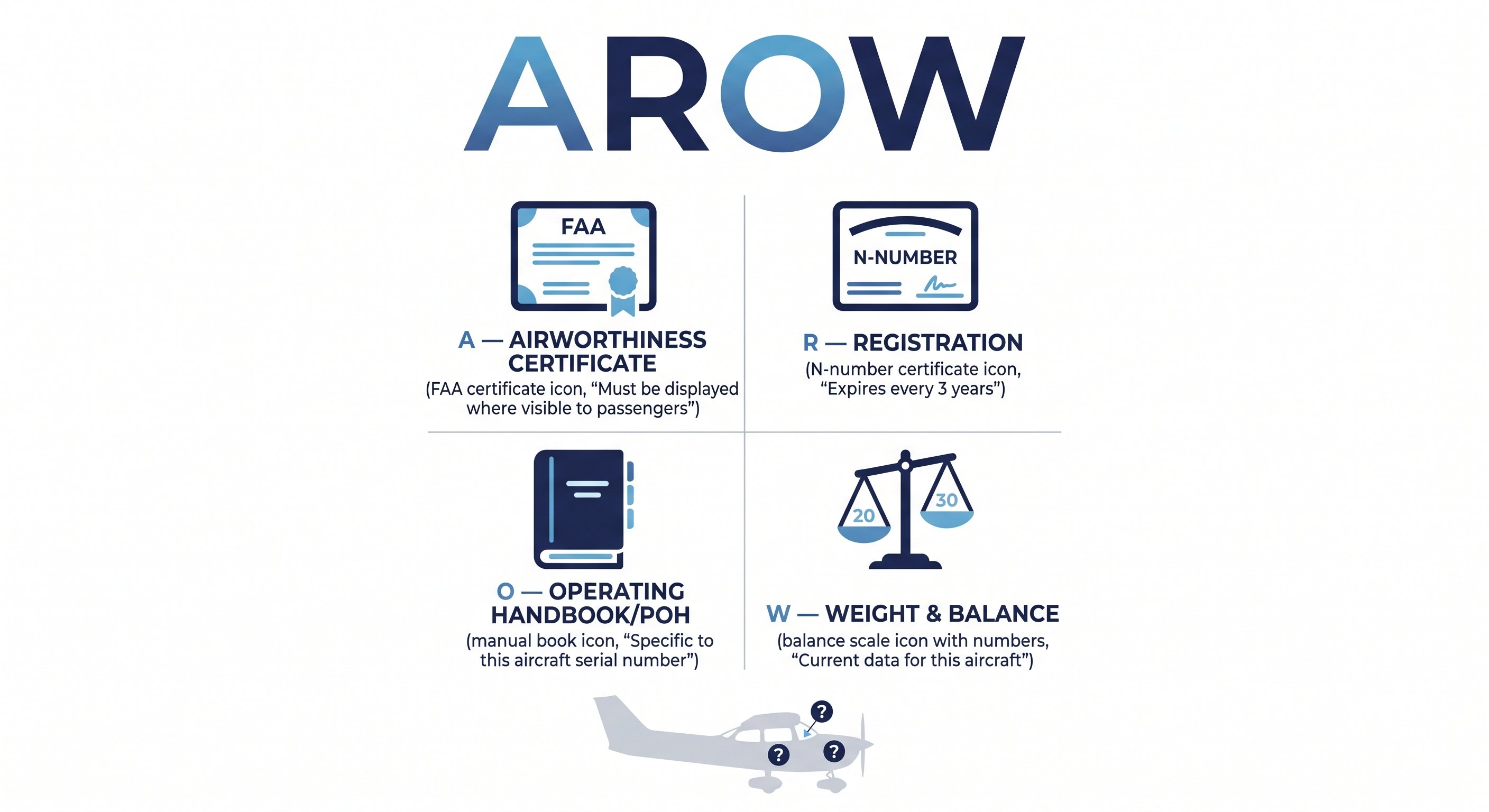
Required Documents (ARROW)
Your aircraft must have these documents onboard and current:
- A — Airworthiness Certificate (permanent, displayed in aircraft)
- R — Registration Certificate (must not be expired)
- R — Radio Station License (required for international flight; good practice to have)
- O — Operating Handbook (POH/AFM for your specific aircraft)
- W — Weight and Balance data (current for your aircraft)
Applicant Documents You Must Bring
- Government-issued photo ID
- FAA written test results (passing score within the last 24 calendar months)
- Logbook with instructor endorsements (solo, solo XC, and checkride endorsement)
- Completed FAA Form 8710-1 (IACRA application, signed by CFI)
- Medical certificate (current Third Class or BasicMed)
- Completed cross-country flight plan with weight & balance
Most Common Checkride Failure Points
Knowing where students fail most often helps you prepare. The most frequent busts on the Private Pilot checkride are:
- Oral exam — systems knowledge: Not knowing your aircraft's engine, fuel system, or electrical system in detail
- Oral exam — weather: Inability to decode METARs, TAFs, or read prog charts
- Slow flight and stalls: Losing altitude or heading during the maneuver
- Ground reference maneuvers: Inconsistent altitude or failure to maintain coordination
- Cross-country diversion: Panicking when asked to divert to an alternate airport
- Soft/short field: Not hitting the required ACS tolerances
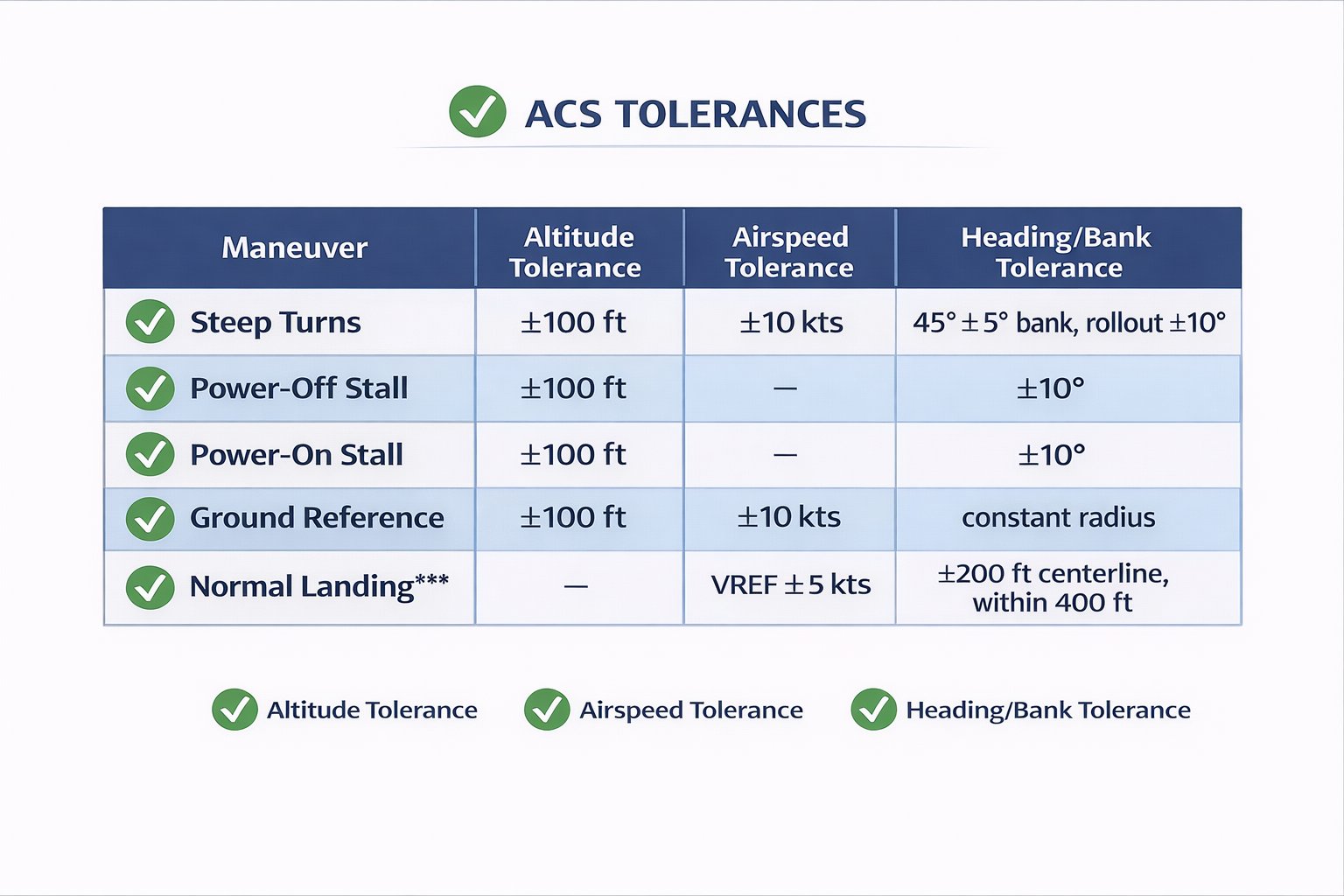
ACS Tolerances to Memorize
These are the standards you'll be held to during the flight portion:
- Altitude: ±100 feet during most maneuvers
- Heading: ±10° during most maneuvers
- Airspeed: ±10 knots during most maneuvers
- Bank angle: ±5° during steep turns
- Steep turns: Maintain altitude within ±100 feet, roll out within ±10° of entry heading
The Night Before Your Checkride
Get a full night of sleep — you cannot take a checkride while fatigued (it's actually an ACS risk management item). Lay out all your documents the night before so you're not scrambling in the morning. Brief the weather for your planned cross-country route and have a backup plan if conditions are marginal.
Most importantly: remember that the DPE wants you to pass. They're not trying to trick you. If you don't know something in the oral, say so clearly and explain how you'd find the answer — that's often good enough. Confidence and sound judgment matter as much as memorized facts.
Several instructors in our directory specialize in checkride preparation and oral exam coaching. Browse CFI listings →