What is the private pilot checkride?
The private pilot checkride is the practical test that, when passed, earns you your Private Pilot License. It is administered by an FAA Designated Pilot Examiner (DPE) — a highly experienced pilot certified by the FAA to conduct tests on the FAA's behalf. The checkride has two parts: an oral examination and a flight test, typically conducted on the same day.
The checkride is evaluated against the FAA Airman Certification Standards (ACS) — a public document that specifies exactly what knowledge, risk management, and skill elements are tested for each maneuver and topic area. Everything on the checkride is drawn from the ACS. Your examiner cannot test you on anything that isn't in it.
Prerequisites — what you need before the checkride
Your CFI determines when you're ready for the checkride and provides the required endorsements. Before the DPE will test you, you must have:
64 free PPL ground school videos on YouTube. Also offers a premium interactive course at freepilottraining.net with 700+ practice questions and a written exam endorsement.
- FAA written test (PAR) passed — within the preceding 24 calendar months. Score is valid for 2 years.
- Logbook endorsements — your CFI must endorse you as prepared for the practical test (FAR 61.39)
- Required flight experience — 40 hours total (20 dual, 10 solo under Part 61), including specific cross-country, night, and instrument requirements
- Valid medical certificate — at least Third Class
- Government-issued photo ID
- FAA written test results — bring the actual results sheet
The 40-hour minimum is almost always exceeded. The national average to PPL is 55–70 hours. Don't feel behind if you're above the minimum — what matters is meeting ACS standards, not minimum hours.
What to bring on checkride day
- Government-issued photo ID (driver's license or passport)
- Original medical certificate (or digital version in IACRA)
- Student pilot certificate
- Logbook with all required endorsements visible and flights logged
- FAA written test results (the actual score report)
- Aircraft documents: Airworthiness certificate, Registration, Operating handbook/AFM, Weight & balance data (AROW mnemonic)
- Current charts (sectional, TAC if applicable, current A/FD)
- Your flight planning materials: E6B or calculator, plotter, navigation log
- Completed cross-country flight plan for the DPE-assigned route
- Your checkride checklist — use our interactive checklist →
The oral examination
The oral portion typically runs 1.5–2.5 hours. The DPE is not trying to fail you — they're trying to confirm that you have the knowledge to fly safely as a private pilot. The tone of most orals is conversational, not adversarial.
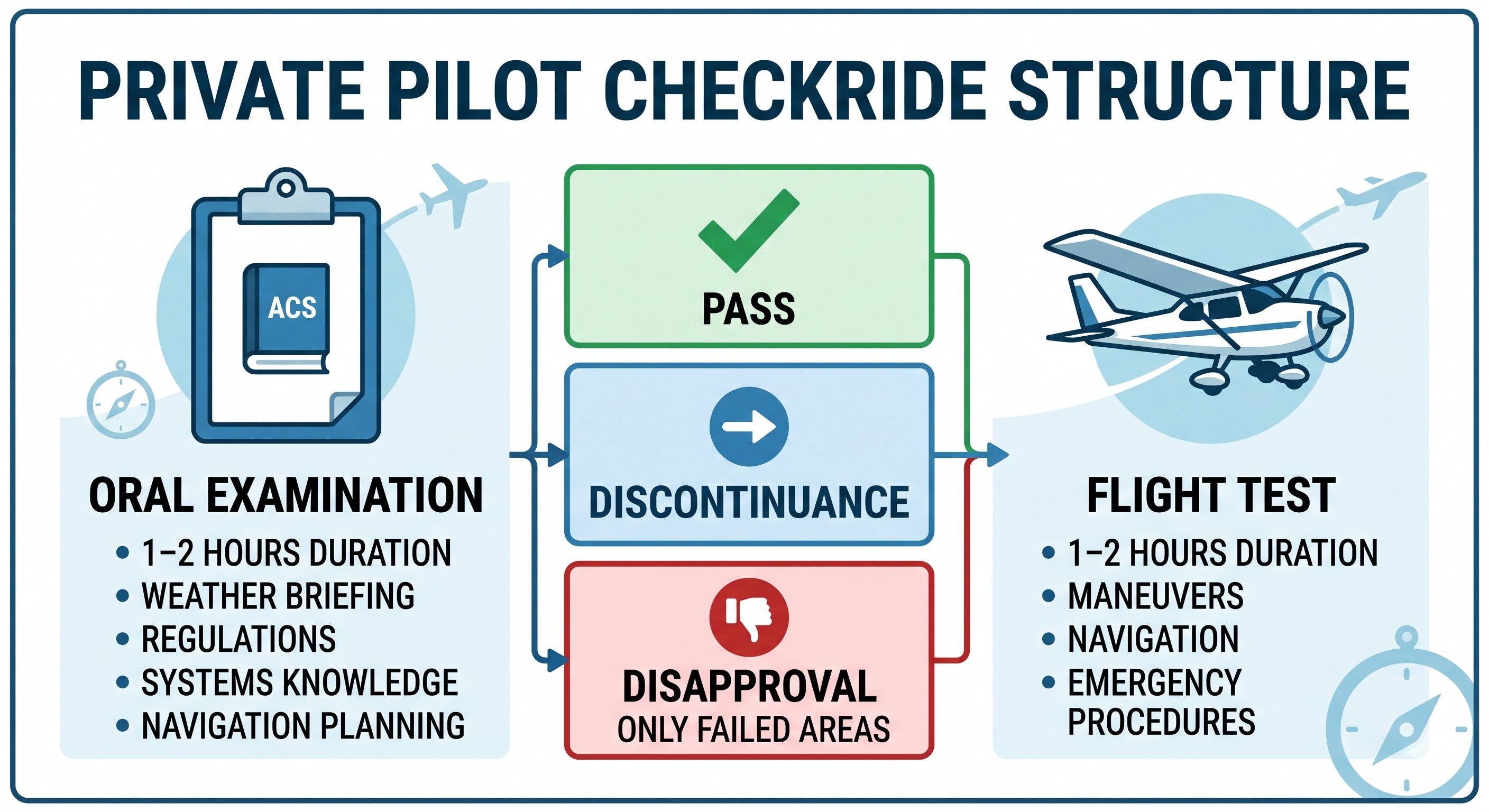
The oral covers every knowledge area in the Private Pilot ACS. DPEs typically start with document review, then work through your cross-country flight plan, then move to topic areas based on what you're likely to encounter on the flight portion.
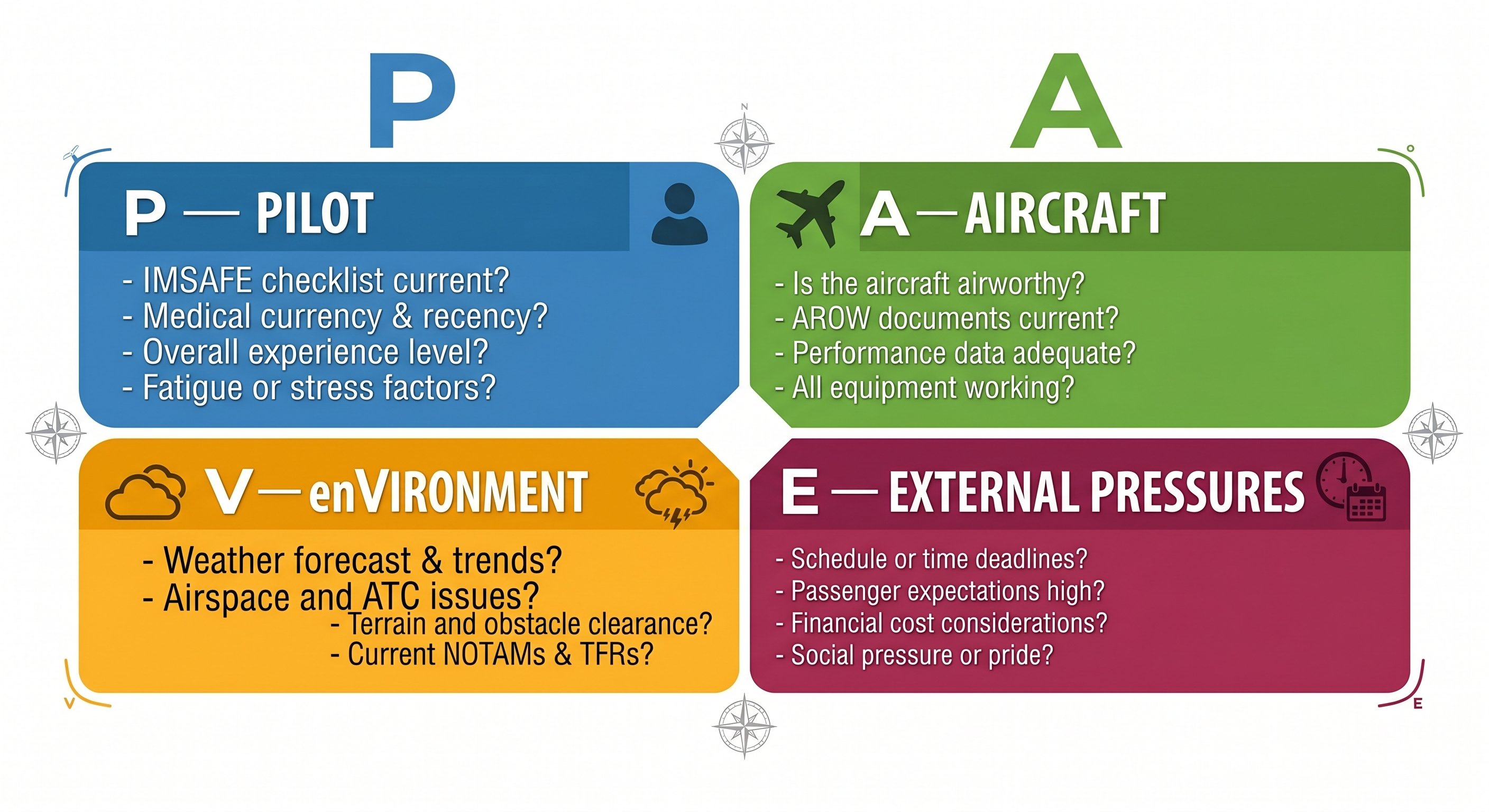
PAVE — the DPE will ask you to demonstrate risk assessment
Major oral exam topic areas
- Regulations — flight rules (FAR 91), pilot currency requirements (61.57), certificates and medical, aircraft equipment requirements
- Airspace — class definitions, entry requirements, equipment requirements, VFR weather minimums by class
- Weather — METAR and TAF reading, prog charts, winds aloft, thunderstorm avoidance, density altitude
- Aircraft systems — your training aircraft's engine, fuel system, electrical system, flight controls, avionics
- Performance and limitations — weight and balance calculations, POH performance charts, takeoff and landing distances
- Navigation — pilotage and dead reckoning, VOR use, GPS, sectional chart reading, NOTAM interpretation
- Cross-country planning — your prepared flight plan, fuel planning, alternates, fuel requirements (FAR 91.151)
- Emergency procedures — engine failure, electrical failure, your aircraft's emergency checklists
- Aerodynamics — lift, drag, stalls, load factors, wake turbulence
- Airport operations — runway lighting, markings, traffic pattern procedures, radio calls
When you don't know something, say so. DPEs respect honest admissions of uncertainty far more than guessing. If you don't know, say "I'm not sure — I'd look that up in the AIM before the flight" or "I'd ask ATC." Making up answers is worse than not knowing.
The flight test
After passing the oral, you move to the flight portion. The DPE will assign a cross-country destination — often different from what you planned for. You'll fly the first portion of that cross-country while demonstrating navigation, communications, and judgment, then the DPE will redirect you to the practice area for maneuvers.
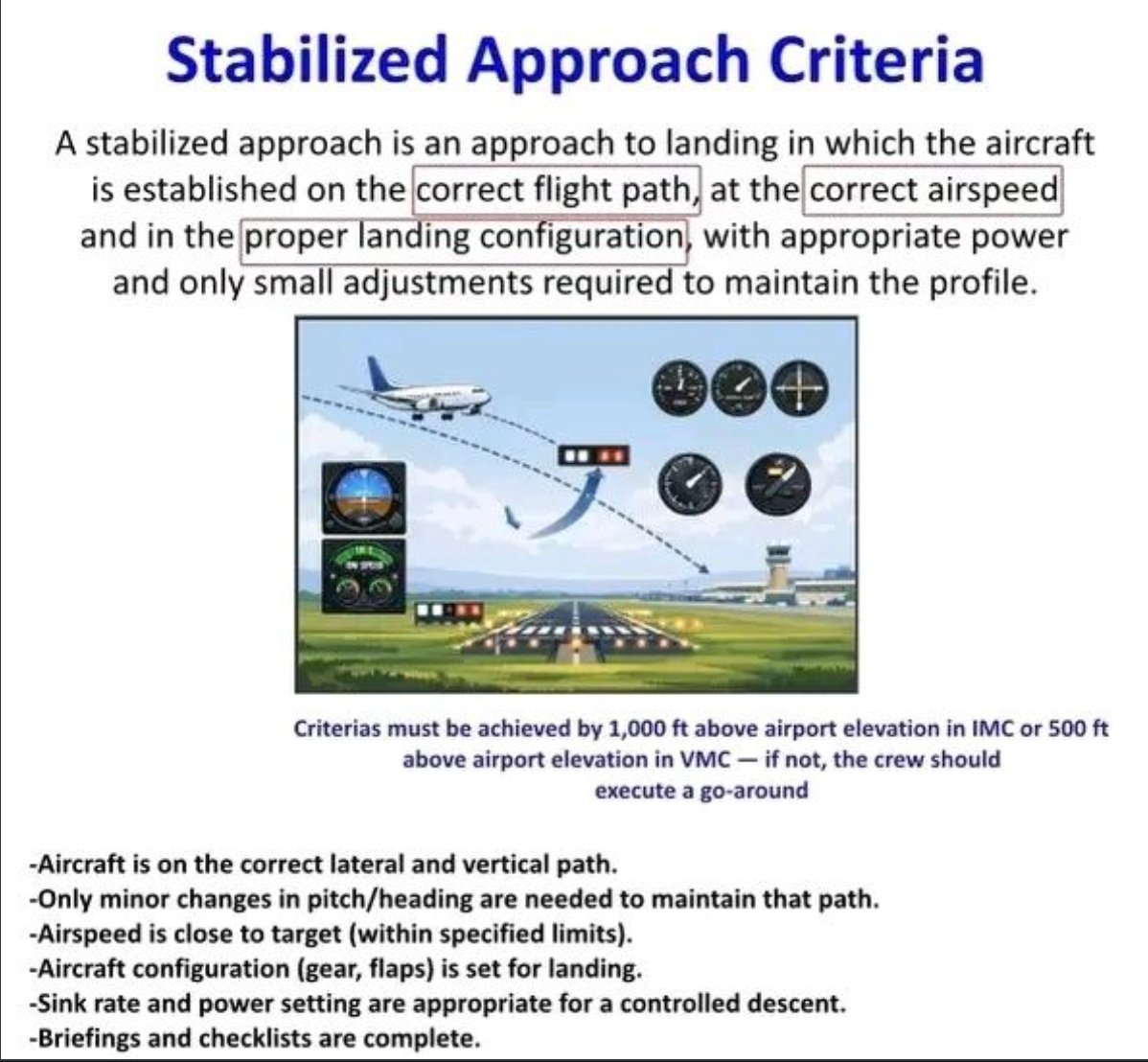
Maneuvers tested on the PPL checkride
- Preflight inspection — systematic inspection per the POH checklist
- Taxiing and runup — proper use of flight controls for wind, full engine runup, checklist use
- Normal takeoff and climb — Vy climb, proper crosswind correction, radio calls
- Short-field takeoff — specific technique per POH, hitting Vx
- Soft-field takeoff — nose up, skim the surface, accelerate in ground effect
- Cross-country navigation — pilotage and dead reckoning, VOR or GPS tracking, fuel/time/position logging
- Diversion to alternate — DPE will direct you to divert; you estimate heading, distance, and ETA
- Lost procedures — what would you do if you didn't know where you were?
- Steep turns — 360° at 45° bank, ±100 ft altitude, ±10° heading, ±10 kts airspeed
- Slow flight — controlled flight at minimum controllable airspeed with prompt recovery to assigned condition
- Power-off stalls — full stall with prompt recovery at first indication of stall
- Power-on stalls — departure stall in climb configuration
- Ground reference maneuvers — turns around a point, S-turns, rectangular course
- Simulated engine failure — best glide, field selection, restart attempt, communication
- Emergency approach and landing — must be able to land within the selected field
- Normal landing
- Short-field landing — specific touchdown point, proper technique
- Soft-field landing — hold off as long as possible, land on mains with nose high
- Forward slip to a landing — DPE may call this on a high approach
ACS tolerances to know cold
- Steep turns: ±100 ft, ±10 kts, ±10° rollout heading
- Stalls: recognize and recover at first indication, ±10° heading
- Slow flight: ±10 kts, ±10°, ±100 ft
- Straight-and-level flight: ±200 ft, ±20°, ±10 kts
- Turns to headings: ±10°
- Short-field landing: within 200 ft beyond the target point
Common checkride failure points
Understanding why students fail helps you focus your preparation. The most common areas:
- Weight and balance errors — math mistakes on the oral. Practice this until it's automatic.
- Weather interpretation — unable to read a TAF or METAR fluently under pressure
- Airspace knowledge gaps — especially Class B entry requirements and equipment
- Steep turns — altitude control in 45° bank is harder than it looks; practice until it's habit
- Emergency landing field selection — choosing an unsuitable field, or not committing
- Short-field landings — poor approach speed management, landing long
- Aircraft documents — arriving without a current chart, or airworthiness certificate in the aircraft
- Not knowing the aircraft systems — "how does the fuel system work" is almost always asked
A discontinuance is not a failure. If weather prevents the flight portion, or the aircraft develops a maintenance issue, the DPE can issue a Letter of Discontinuance. You keep credit for the oral and reschedule the flight portion. A discontinuance does not count as a failure and goes on no record.
How to prepare
60 days before
- Pass the FAA written test — study the full question bank (Sporty's or Pilot Institute courses provide the endorsement)
- Review the Private Pilot ACS — read the standards document once through so nothing surprises you
- Complete all required solo cross-country time
2 weeks before
- Do a full mock oral with your CFI — treating it exactly like a real checkride
- Practice the maneuvers you're weakest on until they're consistently within ACS tolerances
- Build a checkride binder: all documents, current charts, POH sections for common oral questions
- Use our interactive checkride checklist to verify everything
Night before
- Check NOTAMs and weather for the checkride airport and surrounding area
- Complete your cross-country flight plan for your home airport to a likely destination (your DPE may use it or assign a different one)
- Lay out everything you need to bring
- Get a full night of sleep — fatigue is a real performance impactor
Morning of
- Get a full weather briefing (1800wxbrief.com) and note anything the DPE might ask about
- Arrive 15–20 minutes early
- Brief the preflight as you would for any flight — the examiner is watching from the start
If you don't pass
A failure (Notice of Disapproval) is not the end. The DPE is required to tell you specifically which ACS areas you didn't meet. You receive credit for all areas you did pass — you only need to retest the areas you failed. Your CFI must re-endorse you for the areas that were failed. Most pilots who fail one area pass on the retest.
First-attempt pass rate for the PPL nationwide is approximately 80%. That means one in five students doesn't pass the first time. If it happens to you, it's disappointing but extremely common — work with your CFI on the specific deficiencies and reschedule when you're truly ready.
Use our interactive checklist to track everything you need for checkride day — organized by certificate level.
Checkride Checklist →Key references
- FAA Private Pilot ACS (official document)
- FAR 61.39 — Prerequisites for practical tests
- FAR 61.45 — Practical tests: Required aircraft and equipment
- FAA-H-8083-3C — Airplane Flying Handbook (required reference)
- FAA-H-8083-25B — Pilot's Handbook of Aeronautical Knowledge